|
| Dr. DiTullio worked hard to transform this blank wall on the third floor of the C building to accommodate the permanent installation of some geological survey maps and pictures related to astronomy. |


 |
| In a galaxy.......far....far......away....... |
|
| Dr. DiTullio worked hard to transform this blank wall on the third floor of the C building to accommodate the permanent installation of some geological survey maps and pictures related to astronomy. |
|
| In a galaxy.......far....far......away....... |
 |
| In Forensics, Alex examines a pelvic girdle and sacrum looking for characteristics that will enable him to identify the sex of the individual. |
 |
| First year Science Research students practice presenting scientific papers they have read in their search for a topic to pursue in their own original research. Here Tepi is introducing a paper she read relating Korsakoff's Syndrome to damage in the frontal lobe of the brain. |
 |
| Ivan describes the occipital bone's characteristic structure to Xavier as he examines a skull to determine its sex, race, and age. |
 |
| Jackie, another first year Science Research student, presents the paper she read on the use of "low tech" additives to cleanse water of human fecal contamination, effectively, simply, and most importantly cheaply!. |
 |
| Janelle, Ally and Nick examine casts of human maxillae to determine their race. |
 |
| In Chem II Honors, Luke is identifying some of the physical properties of a variety of substances. Here he observes the magnetic properties of iron filings. |
 |
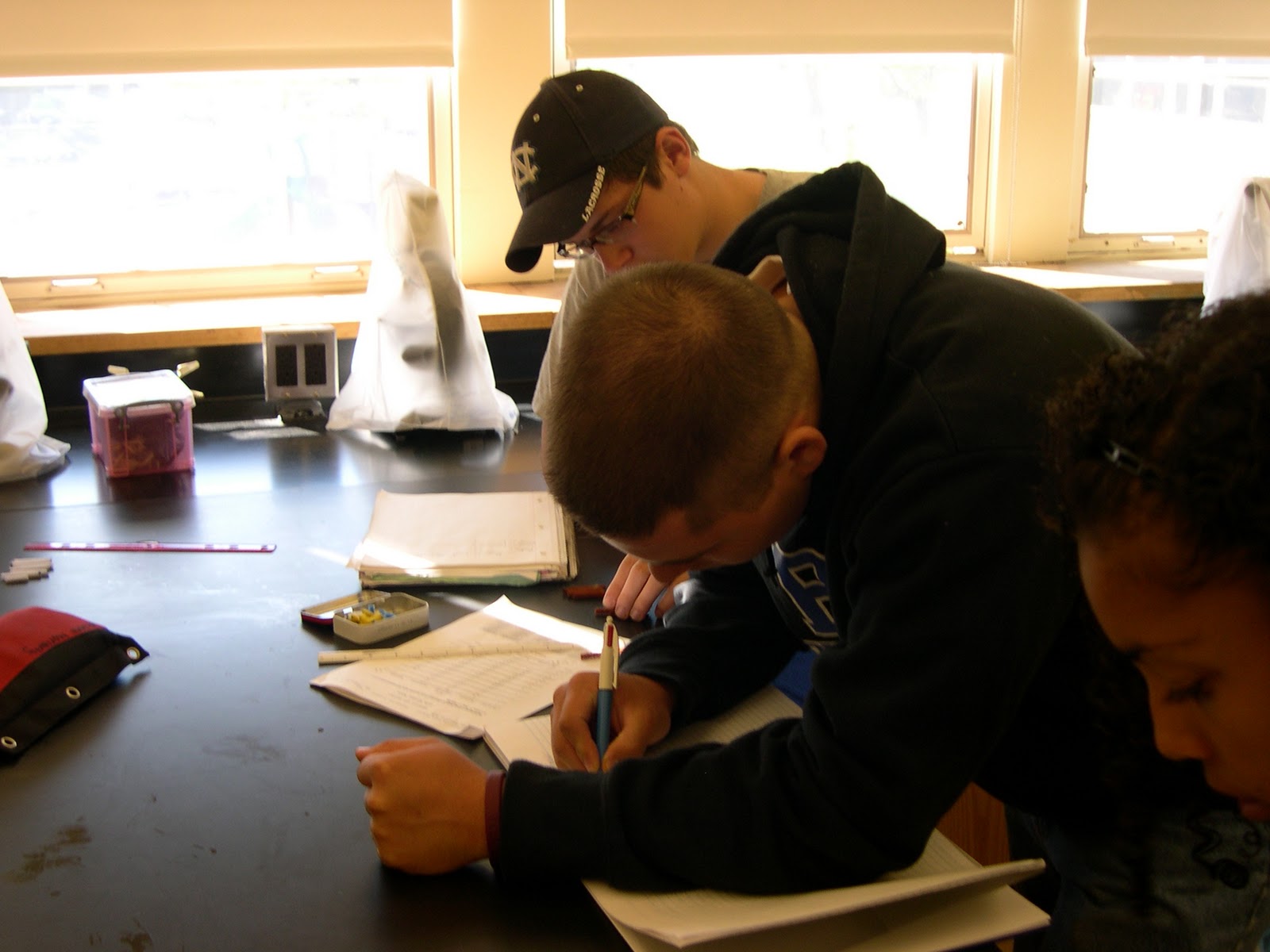
| AP Biology students are examining the phenomenon of osmosis and the effect of a synthetic membrane on the movement of water into or out of a cell. The dialysis bags were filled with various strength sugar (1M, 0.8M, 0.6M, 0.4M, and 0.2M) solutions and then placed in distilled water. The students noted the mass of the bags before and then after the bags were immersed in the distilled water for 30 minutes. |
 |
| AP Biology students, David and Brad, are determining the water potential of potato samples by measuring their mass change in various sugar (1M, 0.8M, 0.6M, 0.4M, and 0.2M) solutions. |
 |
| Chem II Honors students, Claudia and Jack, analyze their observations of the physical properties of various substances. |
 |
| Chem II Honors student, Luke points out how the iron filings are attracted to the magnet. |
 |
| In Chem II Honors, "Big Henny" shows the proper technque needed to assess if a particular solid substances will react with a specific liquids using a spot plate. |
 |
| Forensics' students collate their data for the Maggots and Murder Lab in which they studied four cases by measuring the "maggots" found on the corpses and estimated a TOD (time of death) based on the species present and their growth. |
 |
| Devon and Kyrie measure the length of their "maggots" while Michael tabulates their data. |
 The White Plains Invitational Symposium/Competition was held this past Saturday afternoon at White Plains High School. In this competition, sophomore students in science research programs from Westchester County High Schools present their work. This entails the production of a project display which must include the following sections: an abstract, a review of literature, a hypothesis, methods and materials, and projected results. Each student stands by their display to explain and answer questions about the work. Each display is judged four times by judges, who meet individually with the student.
 There were a total of 198 students from schools including but not limited to Scarsdale, Edgemont, Ossining, Yorktown, and White Plains. Projects were placed into categories based on the branch of science being investigated. A few of the many categories included Botany, Behavior, Medicine and Health, Computer Programming and Astronomy. In each category, the top three scorers are awarded prizes.
 The symposium opened with a presentation by Dr. Nicole K. Davi a staff scientist at the Lamont-Doherty Earth Observatory of Columbia University's Tree-Ring Laboratory in Palisades, NY 10964. Dr. Davi was awarded her Ph. D in Physical Geography (Paleoclimatology) from the Department of Geography at Rutgers New Jersey. The presentation described her use of tree rings to trace the periods of drought that have impacted the nomadic peoples of Mongolia.