Tuesday, September 24, 2013

Forensic Student's Independent Lab Project

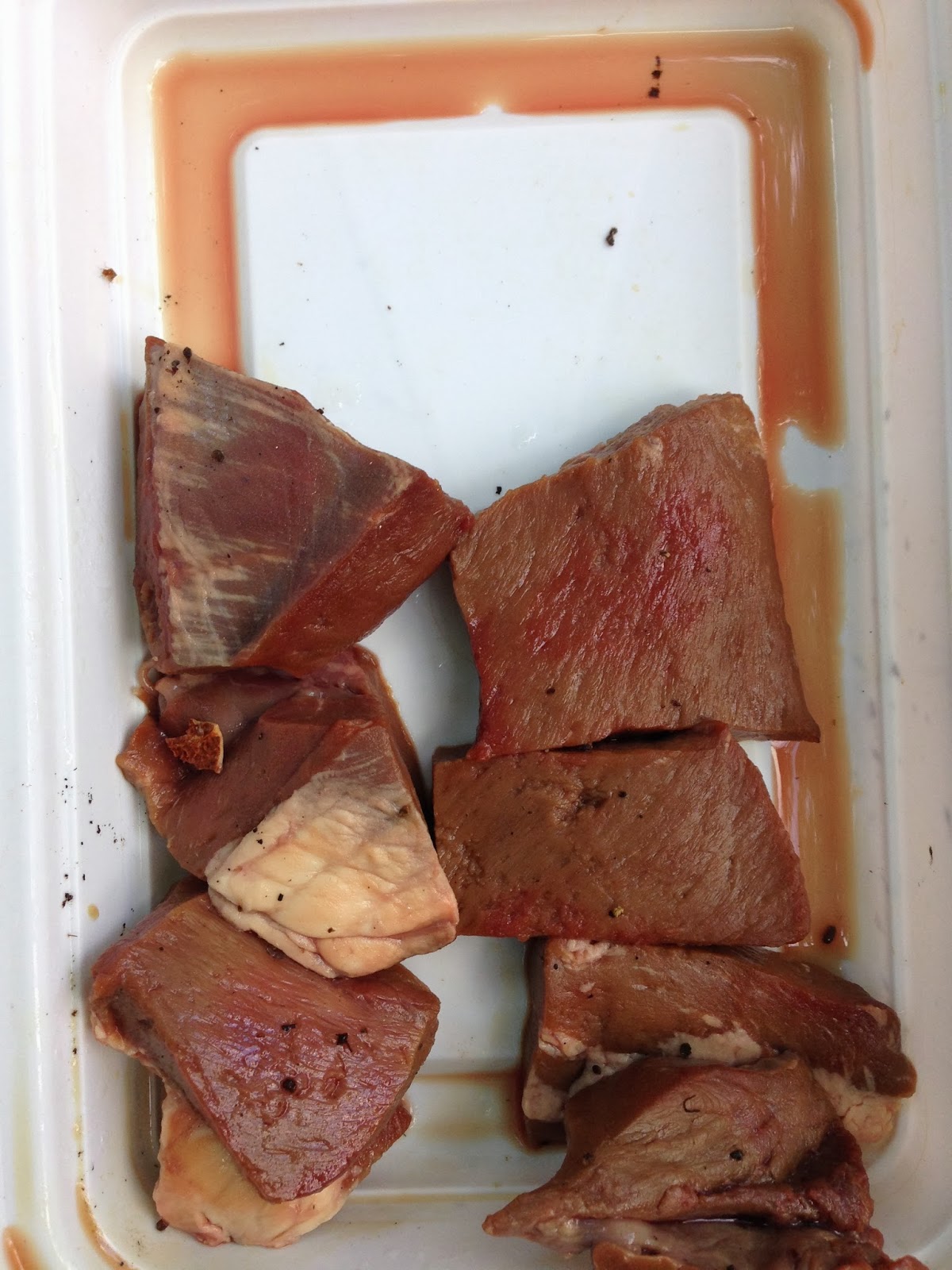
K. Marrinan, V. Mroz and K. Toal have begun an independent inquiry to study Forensic Entomology. They are planning to examine the insect fauna on meat samples they have placed outside overnight. After initially leaving the meat partially uncovered giving insects access, they will cover the meat and exam the growth of insects. The meat is being used to represent how insects are involved in the decomposition and decay of a human corpse if left out in the environment.The students used two different types of meat, beef liver and beef heart.
Notice the "white" eggs deposited on this piece of beef heart.
Fly examining this sample of beef heart
Flies and a cricket visiting this sample of beef liver.
Here the white material looks to be newly laid flesh fly maggots. The flesh fly is an oviviviparous layer, meaning its eggs hatch within the female's body, and living maggots are laid on their food source.
A yellow jacket is examining the beef liver.
Fly leaving the beef liver, savoring its "tastes" and cleaning its sensors on it first pair of legs
A metallic green blow fly visits the beef liver. This species of fly is oviparous, meaning it lays only unhatched eggs.

Thursday, September 12, 2013

AP Biology Students Investigate Osmosis and Diffusion

In the AP Biology course the students carry out two proscribed protocols/procedures related to osmosis and diffusion. In one they use agar cubes to represent various sized cells. They then measure how far into the cells the materials diffused over a fixed period of time. They then calculate the rate of diffusion. They also calculate surface area to volume ratios. In the second protocol, they use dialysis tubing to represent cell membranes. Varying molarity solutions are place in the "cells" the their masses before immersion in water and after immersion are recorded. Finally, the students are given the task of devising their own investigation based on the two required protocols. They will be examining the effects of molecule size, molecule concentration, and other variables on the rate of diffusion/osmosis.

Lab 4 Diffusion and Osmosis by Charles Ippolito

Bertillion's Anthropometry Activity/Lab

The forensic science class is investigating or experiencing an early method used to identify individuals developed by Alphonse Bertillion. It involves making numerous measurement of various body parts.


Sunday, September 8, 2013

From the Sarah Lawrence College Center for the Urban River at Beczak:

Students! Looking for something to do this fall? Enjoy spending time outdoors and working with children? The Education Staff is seeking student (age 16+) volunteers to assist with our Saturday programs. Activities include seining, river activities, and arts and crafts. Volunteers are needed during the day on Saturdays from September - November. For more information please contact Jason at


Sunday, July 14, 2013

NYSUT "What We Do" Profile of Justine Davies

Follow this link to see NYSUT article on Justine Davies' Living Environment Class and their field work studying the Bronx River Ecosystem
NYSUT "What We Do" Feature

Wednesday, July 3, 2013

John Boy Ubaldo's Bloomberg TV Interview about GMOs

John Boy Ubaldo is the farmer from Cambridge NY, from whom we purchase our pork, beef, and this summer we are participating in his CSA. In a CSA we get a box of vegetables and fruits from him each week. John raises hormone, antibiotic and GMO free Berkshire pigs and Black Angus cattle. Here he is talking about why we should insist on labeling of GMO products.


Friday, June 7, 2013

AP Biology 4th Quarter Projects

The Juniors in the AP Biology class were given an open assignment for their fourth quarter project. They were asked to examine any topic in biology that interested them and was not covered in detail in the course of our studies this year. Most of the students chose to concentrate on Human Anatomy, Physiology and Diseases. Most of these topics were somewhat covered in much less detail in the revamped curriculum. These presentations are "uncorrected or edited" by the teacher. They are as originally submitted by the students.

D. Borcich - Honey Bees

E. Choi - Circulatory System


A. Chrappa - Norovirus


M. Chrisanthopoulos - Human Brain


T. Donohue - Melanoma


J. Dougherty - Sickle Cell Anemia


M. Foley - Epilepsy


A. Jones - Cerebral Palsy


M.Laurence - Cognitive Neuro Science and Music


H. Lilly - Tuberculosis


E. McGough - Color Blindness


G. O'Toole - Stem Cells


S. Past - Huntington's Disease


A. Petnuch - Human Body Systems


N. Petnuch - Kingdom Animalia Phylum Chordata


N. Weiens - Down Syndrome