Monday, March 18, 2013

Middle School Science Olympiad Team

Middle School Science 2012-2013 Olympiad Team
 
On Saturday, March 2 the Middle School Science Olympiad team competed in the Lower Hudson Valley competition at Scarsdale Middle School. Congratulations to all the team members and their coach, 8th Grade Team Leader Jean Windels.

Anton and Zip are pleased with their medal win in the "Mission Possible" - competition in which they had to design and build a "Rube Goldberg device

Kenny and David with their flying helicopter.

Kenny and Michael snagged a first place medal for their performance in the "Dynamic Planet" event in which they answered questions about glaciers.

Buz and Emmet won a medal for the "Helicopter Egg Drop" event, in which the students had to design a device that could drop an egg from a height of 8 meters without breaking the egg.

Michael and Jason received second place medals for the "Road Scholar" event in which they were required to read and answer detailed questions about the information present on a road map and a topographic map.

Sasha and Kirsten also won medals for the "Helicopter Egg Drop" event.

Kenny and Michael agreed to pose for this picture to display the back of the team "uniform" T-shirts.

Kenny and David in the process of flying their helicopter.


Chem II Freezing Point Depression Analysis

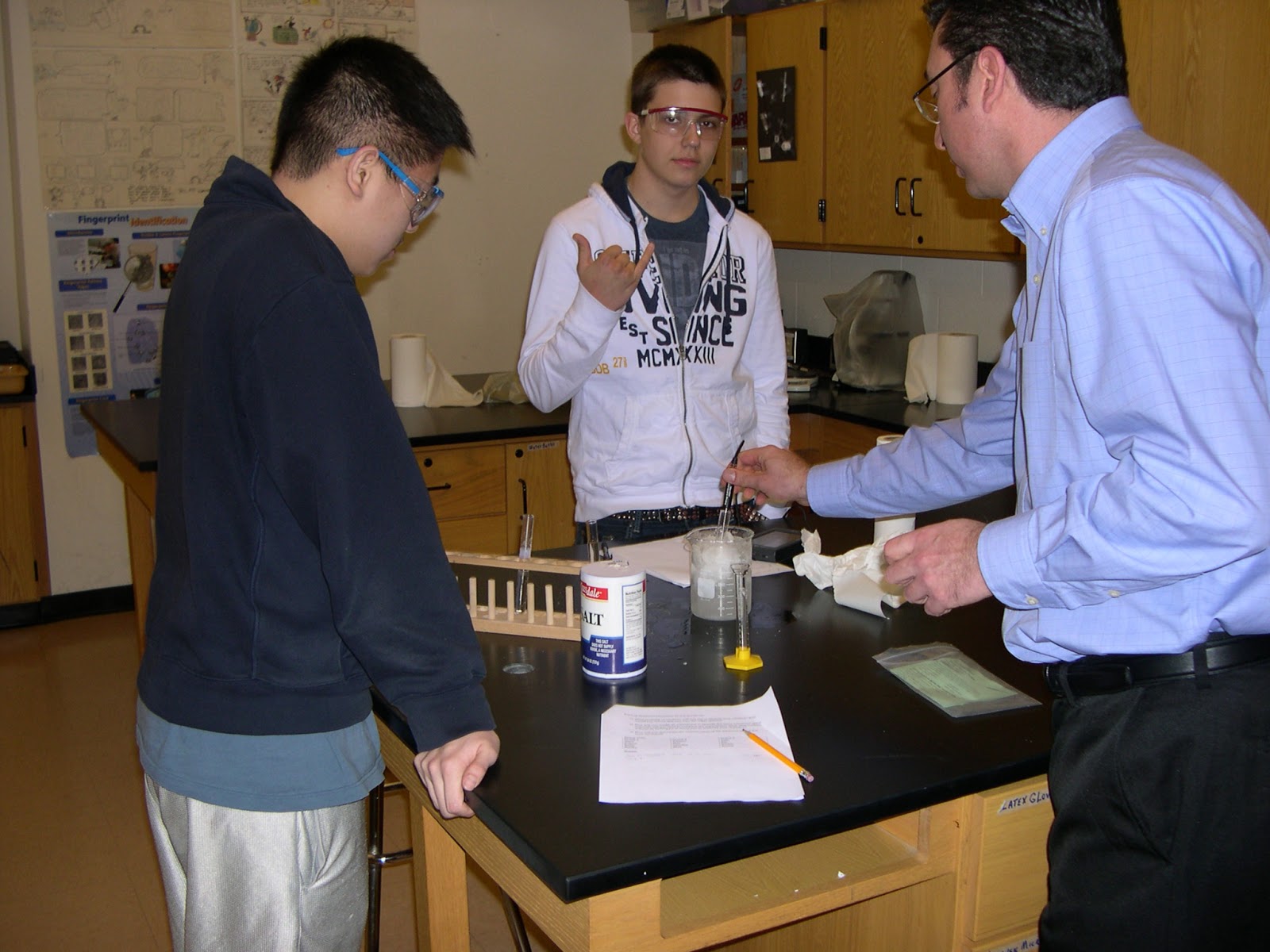
The Chem II students use differences in freezing point depression of three unknown water solutions A, B and C to determine which of the solutions contain sodium chloride, calcium chloride, and sucrose as the solute, in this lab exercise presented by Mr. Nowak.  Once that is determined they will be able to calculate the molality of each solution from the data they collected. The students do know that each solution has the same concentration.

James and Bailie use temperature probes to determine the temperature of three unknown solutions as they approach their freezing points, as Matthew and Jordan look on.

Kenny and Max look on as Mr. Nowak checks their set up.
Alina, Malika and Tatiana decided to use three separate ice baths to bring their solutions down to their freezing points, as Professor Maitland observes their technique during her classroom visit.

The Labques2t Tablet indicates each of the three probes using a different background color. The probes are showing the temperatures of the three solutions (A, B and C) as they approach their freezing points.


Saturday, March 16, 2013

United States Coast Guard Summer Program

The United States Coast Guard is offering this one week program for high school juniors who may be interested in attending the Coast Guard Academy for college.
             

Friday, March 8, 2013

Biome Displays by Environmental Science Class

"Biomes are defined as the world's major communities, classified according to the predominant vegetation and characterized by adaptations of organisms to that particular environment" (Campbell, N.A. 1996. Biology, Fourth Edition. The Benjamin/Cummings Publishing Company, Inc. Menlo Park, CA.).

"The importance of biomes cannot be overestimated. Biomes have changed and moved many times during the history of life on Earth. More recently, human activities have drastically altered these communities. Thus, conservation and preservation of biomes should be a major concern to all." (http://www.ucmp.berkeley.edu/glossary/gloss5/biome/)

As an introduction to their unit on Global Warming/Climate change students in the class researched and produced posters on each of the major biomes found on Earth. The students then "visited" each station to examine and learn about each biome from their classmates, who prepared the posters.

Students were encouraged to document the posters for later study using their smart phones.


Wednesday, March 6, 2013

Environmental Science Climate Presentations

The environmental science class began their global warming unit of study by preparing and sharing displays describing the six major factors that contribute to climate. Pairs of student were each assigned a topic to prepare. The remaining students of the class then rotated through each station to learn about the factors.

Atmosphere Display


Coriolis Effect Display

Carbon Cycle Display

Green House Effect Display

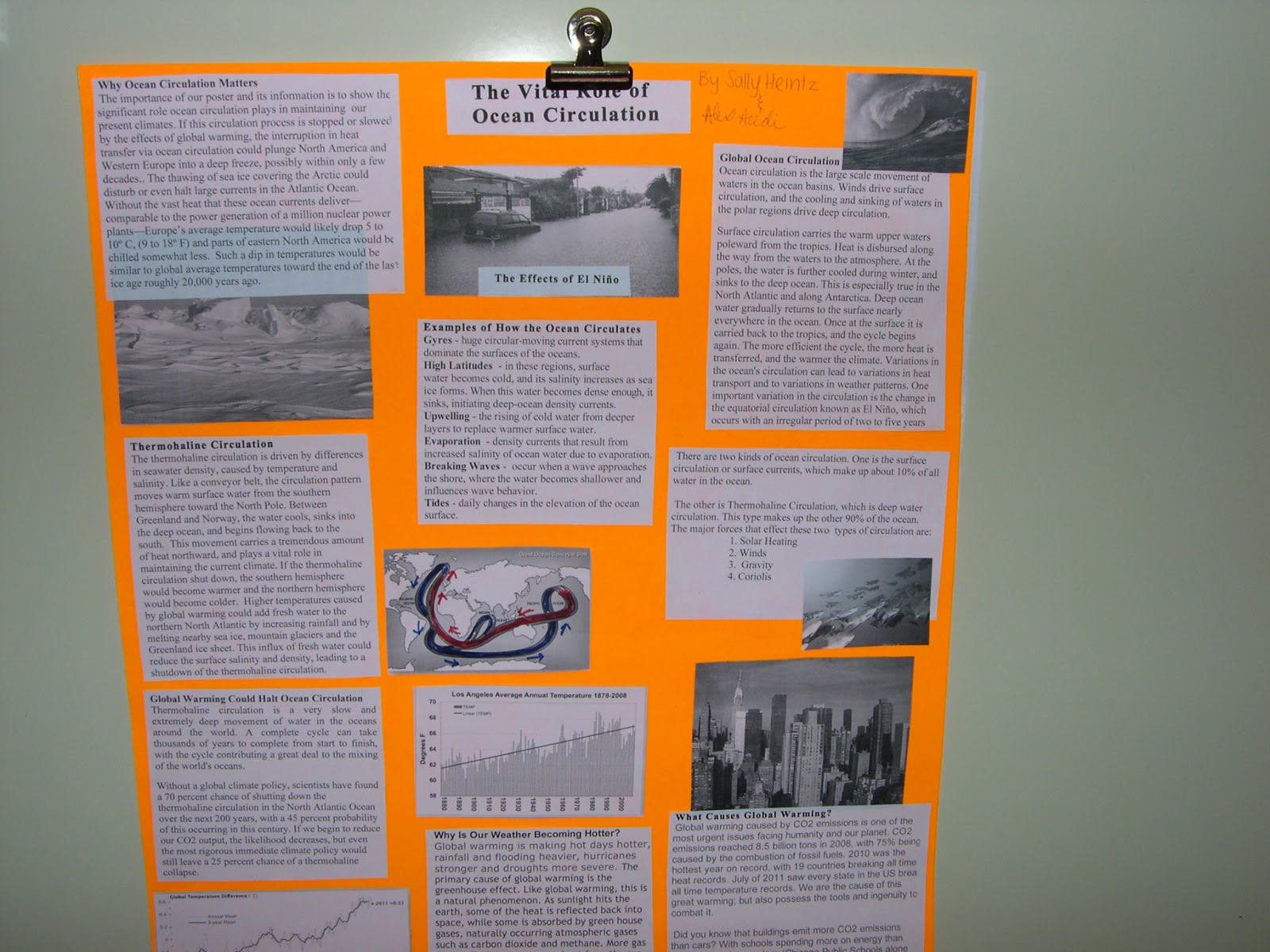
Ocean Currents Display

Solar Radiation Display

Ethan explains how the Coriolis effect contributes to the climate of a particular region.

Alex uses her presentation to explain how the Carbon Cycle contributes to climate.

Asil clarifies the Green House Effect to his classmates.

Claire describes and explains the various layers the compose the atmosphere and how they affect climate.

Paul explains how climate is affected by solar radiation and the tilt of Earth's axis.

Students take notes as Sally explains how Ocean Currents affect climate.


Erin joins Ethan in debunking some common myths about the Coriolis Effect.

Friday, March 1, 2013

Core Earth Science Honors Class Planetary Projects

This quarter's project assignment for the Core Earth Science students was to prepare a PowerPoint Presentation on a planet or heavenly body within our solar system.

Alberghine Frayne Venus by Charles Ippolito

Connor Elder Uranus by Charles Ippolito

Drygulski Neptune Presentation by Charles Ippolito

Giangola Mroz Mercury by Charles Ippolito

Grant Huang Io by Charles Ippolito

Huncke SUN by Charles Ippolito

Louka Owen Jupiter by Charles Ippolito

Lynch Shultz Earth Ppt by Charles Ippolito

McCann Walsh Mars by Charles Ippolito

Minoli Redpath Saturn by Charles Ippolito

Chrappa Gay Mars by Charles Ippolito

AP Biology Students Genetic Diseases Projects

          For their third project the AP Biology students were asked to research a genetic disease.  Their project could be be a well-made PowerPoint Presentation, a Web Site presentation, a comic strip, a storyboard, an animation, video or almost anything. The end product should be a Museum Quality Presentation on a Genetic Disorder. The display should incorporate your creative and artistic talents as well as scientific information.

           The final presentation must include the following sections/information: 

History of the Disease

         A description of when the disease was first identified and by whom.

Symptoms of the Disease

          A description and discussion of how the disease affects those who have the disease and also how it may affect their families.

Cause of the Disease

          A description and discussion of the known/hypothesized etiology of the disease. Be sure to be very specific in this section, if possible describe the exact “mutation” that is thought to produce the ineffective products that are at the root of the disease.


Treatments for the Disease

          A description of any procedures that may be used to alleviate/cure the affected individual’s symptoms.

Identification of the Disease

          A description of any protocols that may be used to determine carriers and/or individuals who might have the disease and the probabilities of their passing the disease to their offspring.

Bioethical Considerations

          A description and discussion of any ethical problems/considerations that may arise in relation to the disease.
 

Adamiyatt Cyrus 11100419 AP Bio Autism Project by Charles Ippolito

Bonfiglio_Brooke_11100436_AP Bio Stickler Syndrome by Charles Ippolito

Borcich Declan 11100310 AP Bio Hemophilia by Charles Ippolito

Choi_Gee-Young_101069_Usher-Æs Syndrome by Charles Ippolito

Chrappa Argentina 11100324 Congenital Heart Defects by Charles Ippolito

Chrisanthopoulos Marika 300453 Cleft Lip and Palate by Charles Ippolito

DeJoy Peter 11100450 Thalassemia Powerpoint by Charles Ippolito

Donohue Timothy 11100338 Glaucoma Presentation by Charles Ippolito

Dougherty Jack 11100340 Color Blindnes by Charles Ippolito

Elbert Gina 11100343 Angelman Syndrome by Charles Ippolito

Jones Andrew 11100364 Gaucher Disease by Charles Ippolito

Laurence Malika 101165 Progeria Final by Charles Ippolito

McGough Elizabeth 11100379 Osteogenesis Imperfecta by Charles Ippolito

O'Toole Grace 11100387 Bloom Syndrome by Charles Ippolito

Past_Samantha_11100388_ap Bio Third Quarter Project; Bipolar Disorder by Charles Ippolito

Petnuch Alexis 300526 Alzheimer's by Charles Ippolito

Petnuch Nicolette 300527 Schizophrenia by Charles Ippolito

Soroori-Motlagh_Nastaran_200705_(SCID) by Charles Ippolito

Weirens Naomi 11100536 Cerebral Palsy by Charles Ippolito